
Annapro A3 Max Review: Clever Design, Disappointing Battery Claims
The Annapro A3 Max is light and highly adjustable, but its unusual halo geometry, unreliable magnetic connection and real battery capacity undermine the specification sheet.
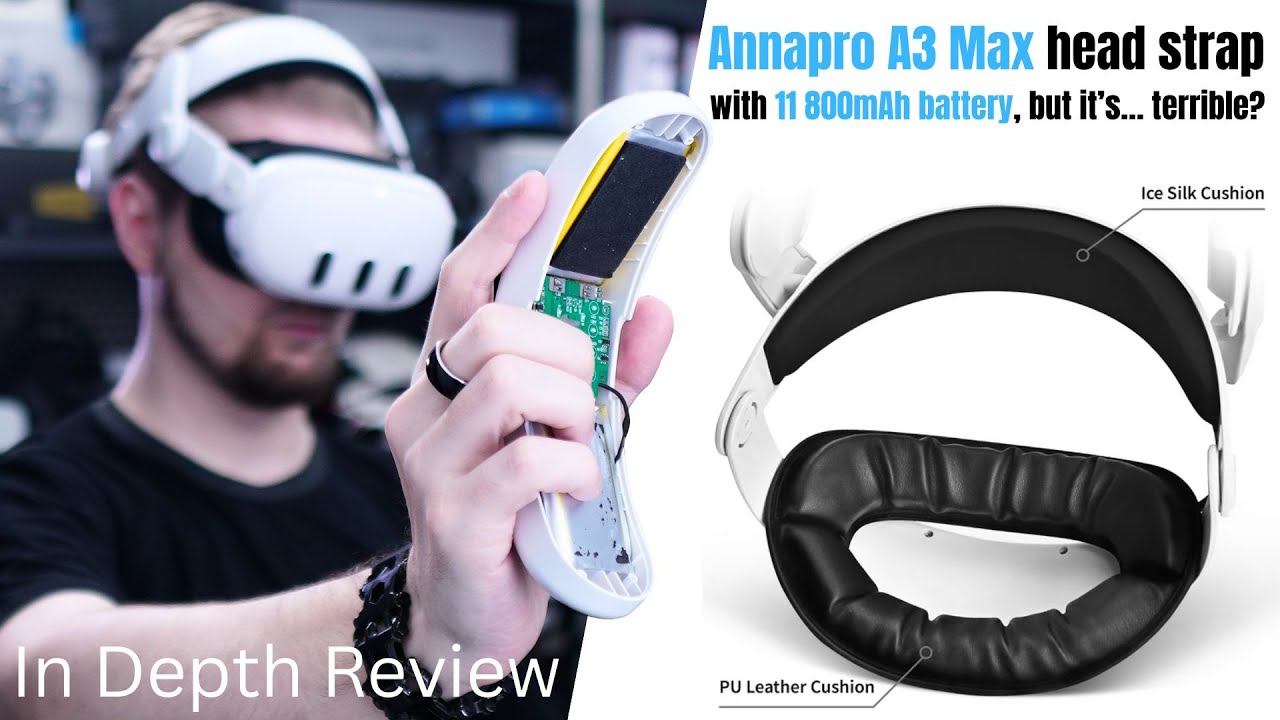
Want the full version? The video review includes all the demonstrations, comparisons and extra details that are easier to show than describe.
Watch the full review on YouTubeDisclosure: The review unit was sent to me for free by Annapro. I use affiliate links always when they are available. If you buy through one of them, I may earn a commission at no extra cost to you.
Quick verdict
The Annapro A3 Max looks exceptional on paper: a light halo strap, a hot-swappable 10,800 mAh magnetic battery, claimed 20 W output and an optional dual-battery charging dock. After a year with the strap and repeated battery measurements, the reality was much less convincing.
The head strap can be comfortable, but its plastic travel stops prevent the Quest from moving close enough to the eyes when the halo is worn low. Cutting those stops made the fit dramatically better on my unit, but modifying a new head strap should not be necessary and may affect the warranty.
The battery was the larger disappointment. Two units repeatedly delivered only about 26–27.5 Wh of usable energy despite a nominal capacity close to 40 Wh, so they are not efficient. The magnetic connection was also the easiest to disturb of any head-strap battery I had tested, sometimes disconnecting and reconnecting during play.
Pros
- Light for a battery halo strap
- Battery can be mounted in either orientation
- Battery is a useful counterweight
- Very broad halo-height adjustment
- Breathable forehead material will suit users who prefer fabric
- Optional CS1 dock charges one or two batteries
- Good color match with Quest 3
Cons
- Can hold the headset too far from the eyes
- Improving the fit required cutting plastic
- Only a fabric forehead pad is supplied; there is no PU-leather alternative
- Fabric absorbs sweat and is a poor match for intensive fitness use
- Magnetic battery detaches too easily
- Charging sometimes disconnected and reconnected without obvious movement
- Measured usable battery energy was far below expectations
- It did not charge Quest faster than BOBOVR B100 in my testing as the specs claims
- Charging two batteries on the CS1 dock was slower than expected
A halo strap that fits differently
Most halo straps can sit relatively low on the forehead while the visor remains close to the eyes. The A3 Max could not do that in its original form. Plastic sections in the side arms stopped the headset before it moved close enough, leaving me with a smaller field of view and an image that was difficult to position correctly.
Raising the halo moves the display closer, but eventually changes the fit toward an elite-style strap: more facial pressure and less of the floating halo sensation. With no facial interface, the higher position also felt less stable than competing halo designs.
I cut the plastic travel stops to fix the problem. The difference was immediate. The headset moved much closer, the halo could sit lower and the strap became genuinely usable. There was still slightly less travel than on some competitors, but it changed the experience from frustrating to acceptable.
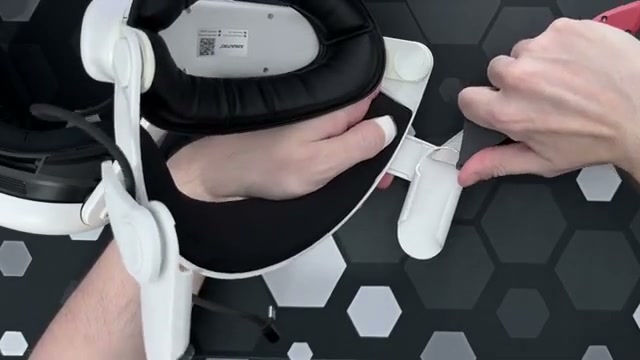 I cut the side-arm travel stop to test whether it was limiting how close the Quest could sit to my eyes.
This is not a reasonable requirement for most buyers. It can damage the product or affect warranty coverage, and the manufacturer should provide the necessary adjustment from the factory.
Forehead pad and long-term construction
Annapro uses breathable fabric across the forehead instead of PU leather. Some users will prefer the softer feel. I prefer PU leather because it grips better and does not absorb sweat. Unlike some competing interfaces and straps, the A3 Max does not include both materials, so there is no choice.
That makes it a poor fit for intensive Beat Saber or fitness sessions where the forehead pad becomes wet. After about a year, some small white parts on my unit had also yellowed, although the main plastic still matched the Quest considerably better than older gray BOBOVR straps.
Battery mounting and reliability
The curved battery can work independently as a power bank and can be installed in either orientation because contacts are present on both sides. Its unusual shape is useful on the head strap but inconvenient in a pocket.
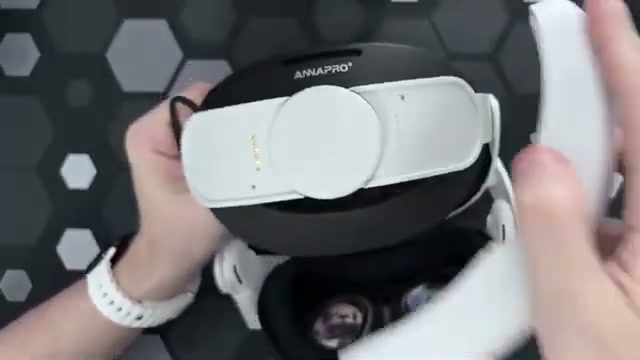 The battery makes contact through the rear mount and can be fitted in either orientation.
The magnetic hold was too weak in practice. Resting against a chair, lying on a pillow or bumping the battery could detach it more easily than any other head-strap battery I had tested. More concerning, charging sometimes disconnected and reconnected while I was playing without an obvious impact. On some occasions I had to unplug and reconnect the cable.
Charging speed and CS1 dock
The battery’s USB-C and integrated-cable output reached approximately 20 W. Trying to draw more caused output to fall below 20 W.It did not outperform BOBOVR B100 as the marketing comparison suggested. Quest normally needs less than 20 W, so this limit is not itself a major practical problem.
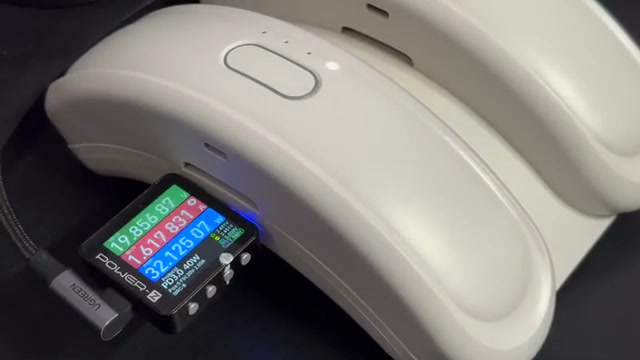 I used a USB-C meter to record the battery’s charging and output behavior.
A single battery took roughly three hours to charge. It accepted its fastest rate for about the first hour and 20 minutes, then slowed toward the end. The CS1 dock charged one battery at approximately the same speed as the battery’s USB-C port.
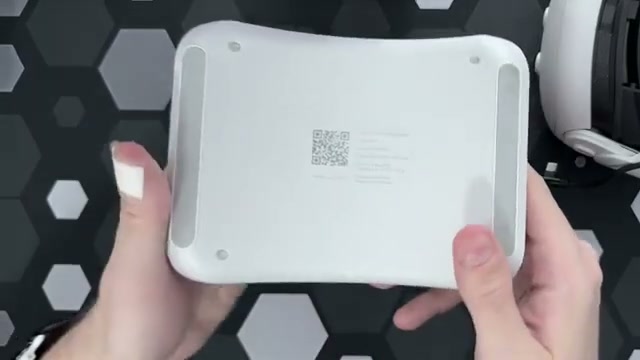 The CS1 charging dock is a separate accessory for one or two A3 Max batteries.
Charging two batteries simultaneously took more than four hours and 15 minutes in my test, despite the dock’s 40 W specification and a power supply that exceeded its requirements.
Measured capacity
The advertised 10,800 mAh rating at 3.7 V implies almost 40 Wh. Comparable Quest battery packs rated around 36 Wh often deliver approximately 31–32 Wh in my measurements.
Across repeated tests, two A3 Max batteries delivered only 26–27.5 Wh at loads appropriate for Quest. A constant 20 W test fell to roughly 24 Wh because the battery could not maintain that output near empty. I repeated the measurements across 5 V and 9 V, magnetic and USB-C outputs, different chargers and separate measuring devices.
Using the headline capacity, the result is roughly 69% efficiency. The cells inside my battery had no visible brand or identifying markings. The pack also became warm during use.
For a game where Quest lasts two hours by itself, the A3 Max extended total time to about four hours and 50 minutes. Competing 10,000 mAh packs with lower nominal ratings reached roughly five and a half hours in the same comparison.
Weight
The battery weighed about 206 g, which worked well as a counterweight. The strap itself weighed about 232 g, making it unusually light for a halo design—around 32 g lighter than KKCOBVR Q3 Pro and about 70 g lighter than the BOBOVR M3 Max/Pro comparison in the video.
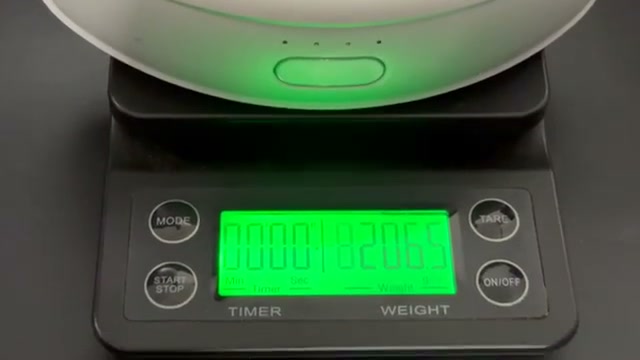 My battery measured about 206 g, which made it an effective counterweight.
Should you buy it?
It is light, can become comfortable and provides enough extra runtime for most people. The problem is the gap between those practical qualities and the marketing claims.
The unmodified fit was wrong for how I wear halo straps, the battery connection was unreliable, and the measured energy was far below what I expected from the specification.
Watch the original video review
Interested in Annapro A3 Max?
These are the same affiliate links I use below my YouTube videos. They cost you nothing extra and help support the channel.